If you run AI workloads, large databases, or memory-hungry analytics on dedicated servers, you've probably hit the same wall every infrastructure buyer eventually hits: the CPU has plenty of cores, but memory capacity runs out first. That's the exact problem CXL 3.2 was built to solve.
Compute Express Link (CXL) is an open, cache-coherent interconnect that connects CPUs, accelerators, and memory devices over standard PCIe infrastructure. CXL 3.2 refines the memory-device management, monitoring, security, and reliability features that earlier CXL generations introduced, and it's quickly becoming a reference point for anyone evaluating dedicated server hardware for AI, machine learning, virtualization, or high-performance databases.
CXL doesn't replace your dedicated server, CPU, GPU, DDR5 memory, or NVMe storage. What it changes is how those resources are connected, expanded, and allocated.
This guide breaks down what CXL 3.2 actually is, what's new in this revision, how memory expansion and memory pooling work in practice, and why the specification matters for the next generation of AI dedicated servers and high-memory hosting infrastructure.
What Is CXL 3.2?
CXL 3.2 is a revision of the Compute Express Link specification released by the CXL Consortium in December 2024. It's backward compatible with earlier CXL generations and focuses on strengthening the operational side of CXL memory devices: management, monitoring, security, reliability, and interoperability.
CXL is built around three protocol families:
-
CXL.io: configuration, device discovery, and I/O operations
-
CXL.cache: coherent host-memory access for accelerators
-
CXL.mem: access to memory attached through CXL
The core shift CXL enables is simple to state but significant in practice: memory stops being a fixed quantity soldered to a single CPU's DIMM slots and starts becoming a flexible resource that can be expanded, shared, pooled, and managed based on what the workload actually needs. For anyone sizing AI dedicated servers or high-memory dedicated servers, that flexibility is the whole story.
Why CXL Matters for Dedicated Server Infrastructure
Conventional server architecture ties memory capacity tightly to the CPU: a fixed number of memory channels, a fixed number of DIMM slots, a fixed maximum capacity. Once you hit that ceiling, scaling up usually means a new motherboard, a new CPU platform, or an entirely new server build.
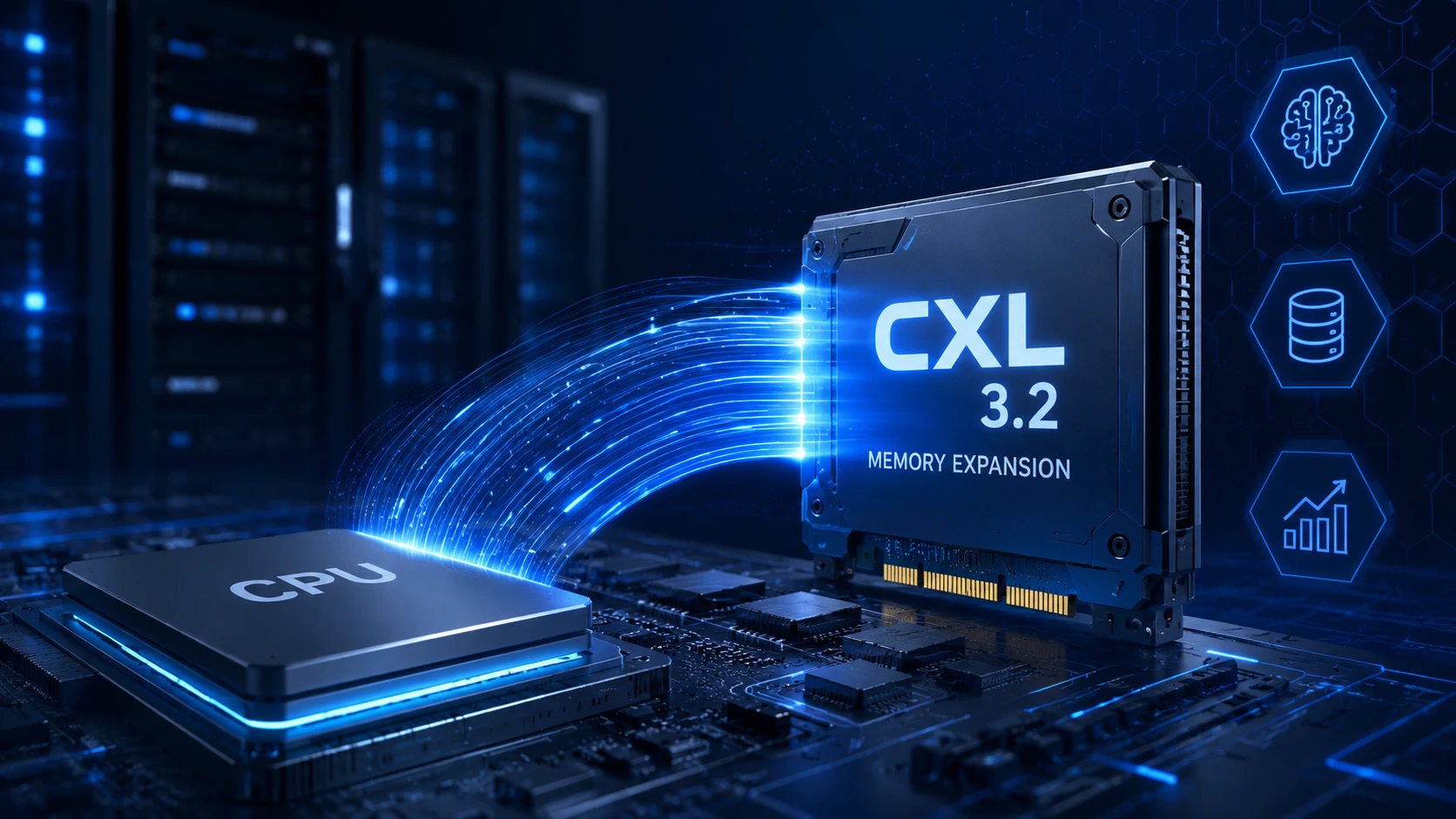
CXL introduces a different path. A CXL memory device connects through a compatible PCIe/CXL interface and adds memory capacity outside the CPU's conventional DIMM population, a route to memory expansion that doesn't depend solely on adding more memory channels.
That matters because a growing share of modern workloads are memory-bound rather than purely CPU-bound, including:
-
Large language model (LLM) inference
-
AI-oriented and in-memory databases
-
Big-data analytics platforms
-
Virtualization and hypervisor-heavy environments
-
Scientific and high-performance computing (HPC)
-
Recommendation engines and real-time analytics
-
Large-scale caching layers
For anyone shopping for dedicated server hosting, the buying question is shifting. It's no longer just "how many CPU cores does this server have?" It's "how efficiently does this platform supply compute, memory, storage, and accelerator resources to my workload?"
CXL 3.2 vs Earlier CXL Generations
CXL 3.2 is an evolution, not a clean-slate redesign. CXL 2.0 introduced switching, memory pooling, and fabric management. CXL 3.0 pushed further into fabric-based resource sharing. CXL 3.1 added direct peer-to-peer CXL.mem support for accelerators.
CXL 3.2 builds on that foundation with additions that include:
-
CXL Hot-Page Monitoring Unit (CHMU)
-
Common Event Record support
-
Online firmware activation
-
Compatibility with PCIe Management Message Pass Through
-
Post Package Repair enhancements
-
Additional performance-monitoring events for CXL memory devices
-
Expanded security via the Trusted Security Protocol (TSP)
-
Additional Integrity and Data Encryption protection
-
Support for HDM-H and HDM-DB memory configuration security
-
Broader compliance and interoperability improvements
These read as operational refinements rather than headline features — but they're exactly what determines whether CXL is ready for production dedicated server deployments rather than lab environments.
CXL Memory Expansion, in Plain Terms
Memory expansion is the most approachable CXL use case. Picture a dedicated server whose CPU already has its full complement of DDR5 memory installed, but the workload still needs more, and adding conventional DIMMs isn't possible or practical.
A compatible CXL memory device supplies that additional capacity through the CXL interface. Rather than treating it like ordinary SSD storage, the system exposes CXL-attached memory as an actual memory resource, sitting much closer to the CPU in behavior than a storage-based overflow would.
That distinction matters because DRAM and SSDs have fundamentally different latency and access profiles. CXL effectively adds a new rung to the memory hierarchy:
CPU caches → local DRAM → CXL-attached memory → storage
The exact implementation depends on the hardware, OS, workload, and CXL topology in use, but the underlying goal stays constant: make memory capacity more flexible without turning every capacity problem into a storage problem.
CXL Memory Pooling: The Bigger Architectural Shift
Memory expansion solves capacity. Memory pooling solves utilization, and it's the more consequential change for dedicated server infrastructure long-term.
In a traditional setup, memory belongs to one physical machine. If Server A has 1TB of RAM and uses only 500GB, that unused half can't help Server B. A pooled CXL architecture changes that relationship: a shared CXL memory pool can be allocated across multiple compute hosts based on real-time demand, which is one of the foundational ideas behind composable and disaggregated infrastructure.
A simplified topology looks like this:
Server A (CPU workload)      →  CXL fabric
Server B (AI workload)       →  CXL fabric
Server C (database workload) →  CXL fabric
                                   ↓
                         Shared CXL memory pool
The real-world capability depends on the CXL topology, switches, memory devices, host platforms, firmware, and management software involved. CXL isn't a software toggle that instantly turns a rack of conventional dedicated servers into a shared-memory cluster — but it establishes a credible architectural path toward that outcome.
How CXL 3.2 Supports AI Workloads
AI is arguably the strongest driver behind CXL adoption. Training and inference both demand large, and often unpredictable, amounts of memory. GPUs deliver massive parallel compute, but accelerator memory capacity remains one of the tightest system-design constraints — and large language models compound the pressure through KV cache and other runtime data structures that grow with context length, concurrency, and batch size.
Here's where CXL 3.2 helps most on AI dedicated servers:
1. Larger effective memory capacity.
CXL-attached memory extends what's available to a CPU platform beyond conventional DIMM
limits, useful for AI inference servers, AI-oriented databases, and analytics systems
with substantial memory footprints.
2. Better memory utilization.
With pooling, memory doesn't have to sit permanently tied to a single host. System
software can allocate it according to actual demand, improving utilization across
workloads with uneven memory patterns.
3. Support for memory-intensive AI databases.
Retrieval systems and AI databases benefit from keeping frequently accessed data in
memory rather than falling back to slower storage paths, one of the reasons CXL-based
memory pools are being explored for large-footprint AI databases.
4. Room for larger KV cache architectures.
As context windows and concurrent requests grow, KV cache becomes a significant memory
consumer in LLM inference. CXL isn't a substitute for GPU HBM, but it's being
investigated as a complementary layer around CPU and accelerator memory.
5. More composable AI infrastructure.
Rather than locking every AI server into one fixed memory configuration, CXL lets
infrastructure teams increasingly decouple compute from at least some memory resources,
allocating capacity where the workload actually needs it.
CXL and GPU Dedicated Servers
CXL is particularly relevant to GPU dedicated servers because GPU memory and system memory serve different roles. High-bandwidth memory (HBM) on the accelerator is optimized for extreme bandwidth close to the GPU; CPU-attached DDR5 provides larger capacity at a different latency and cost point. CXL introduces a further tier:
GPU HBM → CPU DDR5 → CXL-attached memory → NVMe storage
Each layer trades off capacity, latency, bandwidth, and cost differently. CXL isn't trying to match HBM speed; it's providing more flexible capacity and resource management while keeping data off much slower storage paths for as long as possible.
That's a key point for anyone evaluating an AI dedicated server: CXL support alone doesn't guarantee better performance. The full platform CPU, GPU, HBM, DDR5, PCIe generation, CXL topology, memory devices, networking, and software stack is what determines real-world results.
What CXL 3.2 Means for Dedicated Server Infrastructure
Today's typical dedicated server is a self-contained physical machine: CPU, RAM, storage, networking, and any accelerators installed in one chassis and allocated to a single customer or workload. CXL opens the door to something more modular, combining compute nodes, GPU accelerator nodes, CXL memory devices, CXL switches, high-speed networking, NVMe storage, and fabric management software into infrastructure that composes resources around the workload rather than locking them into one physical box.
That's especially relevant for infrastructure supporting AI inference, high-performance databases, and analytics, workloads where memory demand can swing significantly from one deployment to the next.
CXL 3.2 Security and Reliability Improvements
Performance is only half the equation. Once memory becomes a shared or disaggregated resource, security, monitoring, and device management move from "nice to have" to essential.
CXL 3.2 extends security through the Trusted Security Protocol (TSP), expands Integrity and Data Encryption protection, and adds security support for specific CXL memory configurations (HDM-H and HDM-DB). It also improves monitoring and device management through additions like the CXL Hot-Page Monitoring Unit, giving infrastructure operators the visibility into hardware health, firmware state, and error conditions that production dedicated server environments require, not just added capacity.
What Is CXL Hot-Page Monitoring?
The CXL Hot-Page Monitoring Unit (CHMU) gives software visibility into which memory pages are being accessed most frequently, supporting smarter memory tiering. In practice, that can look like:
-
Frequently accessed data kept in local DRAM
-
Less frequently accessed data placed in CXL-attached memory
-
Persistent data kept on NVMe storage
As multi-tier memory architectures become more common, this kind of hot/cold visibility is what makes automated placement decisions possible.
CXL 3.2 and PCIe 6.x
CXL runs over the PCI Express physical layer, and CXL 3.2 is associated with PCIe 6.x, which delivers up to 64 GT/s per lane using PAM4 signaling with Forward Error Correction. That bandwidth matters because CXL depends on fast connectivity between processors, memory devices, and other components.
Link speed alone, though, isn't a performance guarantee. Real-world results also depend on CXL device latency, memory bandwidth, number of CXL links, switch topology, CPU architecture, memory technology, workload access patterns, software support, NUMA behavior, and accelerator design. For dedicated server buyers, the complete system design matters far more than a CXL label on a spec sheet.
CXL vs Traditional DDR5 Memory
CXL memory and conventional DDR5 are complementary, not competing, technologies.
| Feature | Traditional DDR5 | CXL-Attached Memory |
|---|---|---|
| Connection | Directly attached to CPU memory channels | Connected through the CXL interface |
| Latency | Very low | Higher, but closer to memory than storage |
| Capacity | Fixed by CPU and motherboard design | Extends beyond conventional DIMM limits |
| Flexibility | Tied to one physical server | Can support pooling and disaggregation in compatible systems |
| Best fit | Latency-sensitive primary memory | Capacity expansion, tiered and pooled architectures |
For high-performance dedicated servers, the strongest architecture typically uses both — DDR5 for latency-sensitive workloads, CXL for capacity and flexibility.
CXL vs NVMe SSD Storage
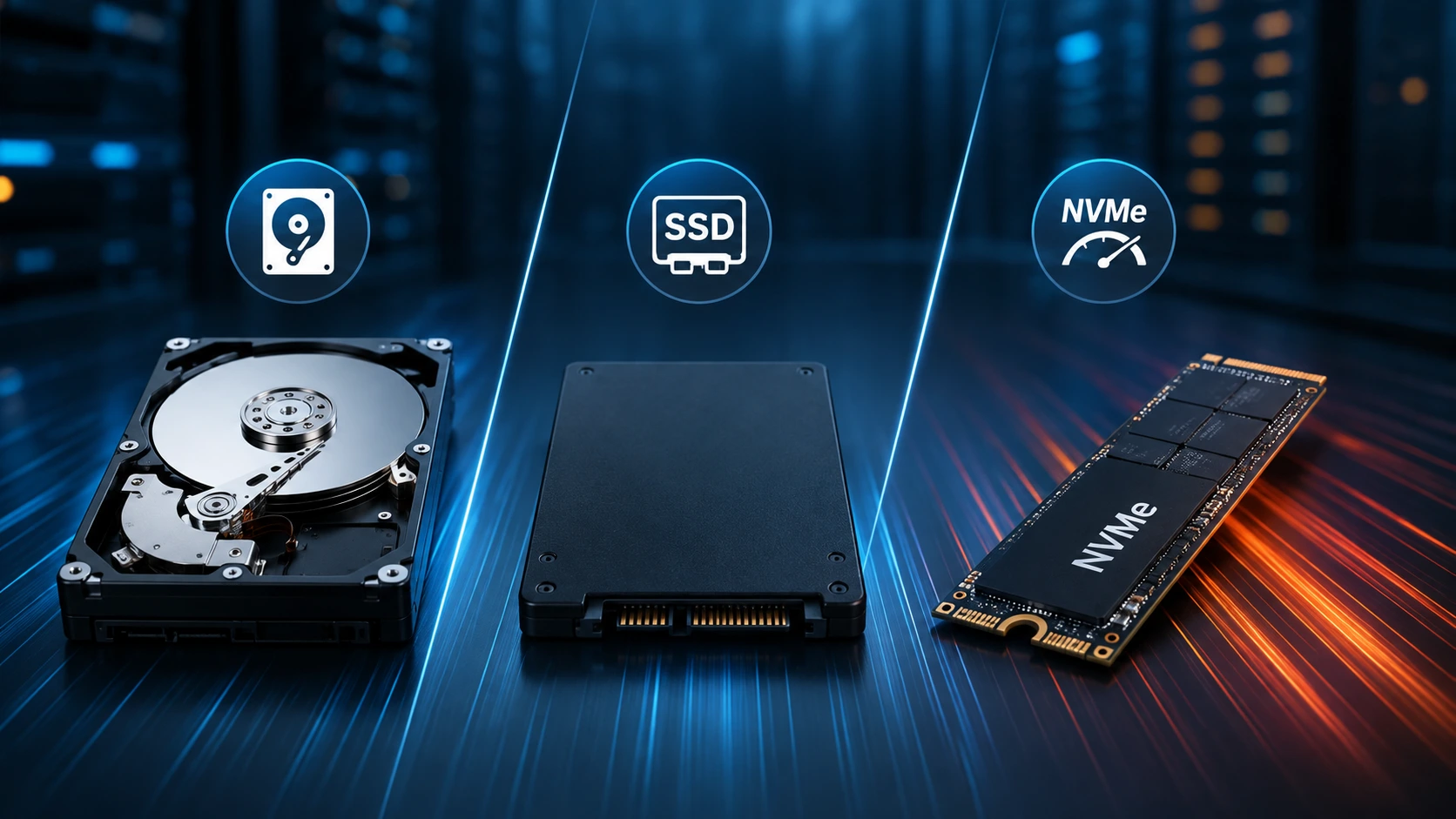
CXL memory and NVMe storage solve different problems and shouldn't be confused. NVMe SSDs are persistent storage devices built for capacity, durability, and fast block-level I/O. CXL memory, by contrast, participates directly in the system's memory architecture.
If a workload needs more persistent storage, NVMe remains the right tool. If it needs more addressable memory or a more flexible memory hierarchy, CXL is the additional option and on modern NVMe dedicated servers, the two technologies work alongside each other rather than competing.
Is CXL 3.2 Faster Than DDR5?
Not in any simple sense. CXL 3.2 is an interconnect specification, not a memory technology designed to universally outrun DDR5. Local DDR5 attached directly to the CPU generally remains the preferred choice for latency-sensitive system memory.
CXL's value lies elsewhere: expanding capacity, enabling memory sharing and pooling, and supporting more flexible memory architectures. It's a technology to evaluate against workload requirements, not headline bandwidth figures.
CXL 3.2 for Virtualization and Cloud Infrastructure
CXL's relevance goes beyond AI. Virtualization environments routinely see uneven resource utilization: one VM needs significant memory while another barely touches its allocation. A more flexible memory layer makes dynamic allocation more practical, and at larger scale, CXL-based memory pooling contributes to composable infrastructure where compute and memory are managed independently.
For dedicated server providers, this could eventually support infrastructure models that sit between traditional bare metal and fully disaggregated cloud architecture, though the real-world implementation still depends heavily on hypervisor support, OS compatibility, firmware, and orchestration software.
What to Check Before Choosing a CXL-Enabled Dedicated Server
CXL is still an emerging infrastructure technology, so it's worth evaluating the full platform rather than picking a server just because "CXL" appears on the spec sheet. Questions worth asking:
-
Which CXL version does the server actually support?
-
Does the CPU support the required CXL capabilities?
-
Which CXL device types are supported?
-
How much CXL memory can the platform address?
-
Is memory expansion supported, memory pooling, or both?
-
Is a CXL switch required for the intended topology?
-
Does the operating system support the required CXL functionality?
-
What monitoring and management tooling is available?
-
How does CXL memory latency compare with local DDR5 in practice?
-
Which specific workloads will actually benefit from this architecture?
For conventional websites, smaller applications, and many general-purpose workloads, local DDR5 and fast NVMe storage still matter more than CXL support. For AI infrastructure, high-memory databases, scientific computing, and large-scale analytics, CXL becomes a genuinely important differentiator.
Where CXL Is Headed in AI Infrastructure
CXL's longer-term significance goes beyond memory expansion. It's part of a broader industry move toward resource disaggregation and composable infrastructure — treating CPU cores, memory, storage, and accelerators as resources that can be connected and allocated to match the workload, rather than fixed components bolted into one chassis.
That flexibility matters more as AI infrastructure grows more heterogeneous, often combining general-purpose CPUs, AI GPUs, specialized accelerators, large DDR5 pools, HBM, CXL memory, NVMe storage, and high-speed network fabrics in the same environment. CXL provides a standardized framework for connecting several of these resources while preserving coherent memory semantics, and the ecosystem is already moving past simple memory expansion, with ongoing work exploring large memory pools for AI databases and inference platforms.
CXL 3.2 vs CXL 4.0: Where the Standard Stands Today
CXL 3.2 is no longer the newest CXL specification; the CXL Consortium released CXL 4.0 in November 2025 with higher bandwidth and additional architectural capabilities. That doesn't make CXL 3.2 obsolete. It established a mature set of features around memory devices, monitoring, security, and management, and hardware built to this specification will stay relevant for years. The most accurate way to think about CXL 3.2 today is as a well-established step in CXL's evolution, not the endpoint of the standard.
Will CXL Replace Dedicated Servers?
No. CXL changes how components inside and across server infrastructure communicate and share resources — it doesn't replace the case for dedicated servers themselves. Dedicated server hosting still matters when customers need exclusive physical hardware, predictable performance, full control over the operating environment, high CPU or GPU performance, large memory configurations, dedicated networking, or compliance and isolation guarantees that shared or virtualized infrastructure can't offer.
The realistic framing isn't "CXL instead of dedicated servers." It's "CXL-enabled dedicated and data-center infrastructure."
Key Benefits of CXL 3.2 at a Glance
-
Memory expansion: add capacity without relying solely on CPU-attached DIMMs
-
Memory pooling: share memory across compatible compute systems and allocate it dynamically
-
Better resource utilization: reduce memory that sits idle on individual servers
-
AI scalability: support memory-intensive training, inference, databases, and analytics
-
Improved device management: monitoring, firmware, event-recording, and reliability tooling
-
Stronger security: extended protections for CXL memory architectures
-
Future-ready infrastructure: a credible path toward composable, disaggregated data centers
Frequently Asked Questions About CXL 3.2
What is CXL 3.2?
CXL 3.2 is a revision of the Compute Express Link specification, a high-speed, cache-coherent interconnect for processors, memory devices, accelerators, and related infrastructure. It improves memory-device management, monitoring, security, reliability, and interoperability.
Is CXL 3.2 useful for dedicated servers?
Yes, particularly for high-memory and specialized workloads. It enables memory expansion and, in suitable architectures, memory pooling. It's most relevant to AI, databases, analytics, virtualization, and HPC rather than basic hosting workloads.
Does CXL 3.2 replace DDR5?
No. Local DDR5 remains important for its lower latency. CXL complements DDR5 by adding another memory tier and enabling more flexible capacity.
Does CXL replace NVMe SSDs?
No. NVMe provides persistent storage; CXL memory participates in the memory hierarchy. Modern servers typically use both for different requirements.
Why is CXL important for AI dedicated servers?
AI workloads increasingly need large memory capacity for model parameters, datasets, KV cache, databases, and runtime state. CXL supports memory expansion and pooled-memory architectures that make capacity more flexible.
Is CXL 3.2 the latest CXL version?
No. CXL 4.0 was released in November 2025. CXL 3.2 remains an important, mature specification and a useful reference point for understanding CXL's evolution.
Should every dedicated server support CXL?
No. CXL is most valuable when a workload genuinely needs memory expansion, pooling, or disaggregated resource management. For many general-purpose dedicated servers, conventional DDR5 and NVMe storage remain the right architecture.
Final Thoughts
CXL 3.2 is a meaningful step toward treating server memory as a flexible resource rather than a fixed quantity bolted to one CPU. It can be expanded, monitored, shared, pooled, and, eventually, composed across larger infrastructure. For AI dedicated servers and high-performance hosting environments, that shift matters more every year as models, datasets, and inference workloads keep growing.
CXL 3.2 isn't a universal performance upgrade, and it won't make every dedicated server faster. Its real value is architectural: another way to work around memory-capacity limits and build more adaptable infrastructure. As CXL 4.0 and later generations mature, expect the technology to become steadily more relevant to AI data centers, high-memory servers, composable infrastructure, and next-generation dedicated server platforms.
If you're planning a dedicated server for AI, databases, virtualization, or other memory-intensive workloads, understanding CXL now puts you ahead when it comes time to make an infrastructure decision.