Introduction
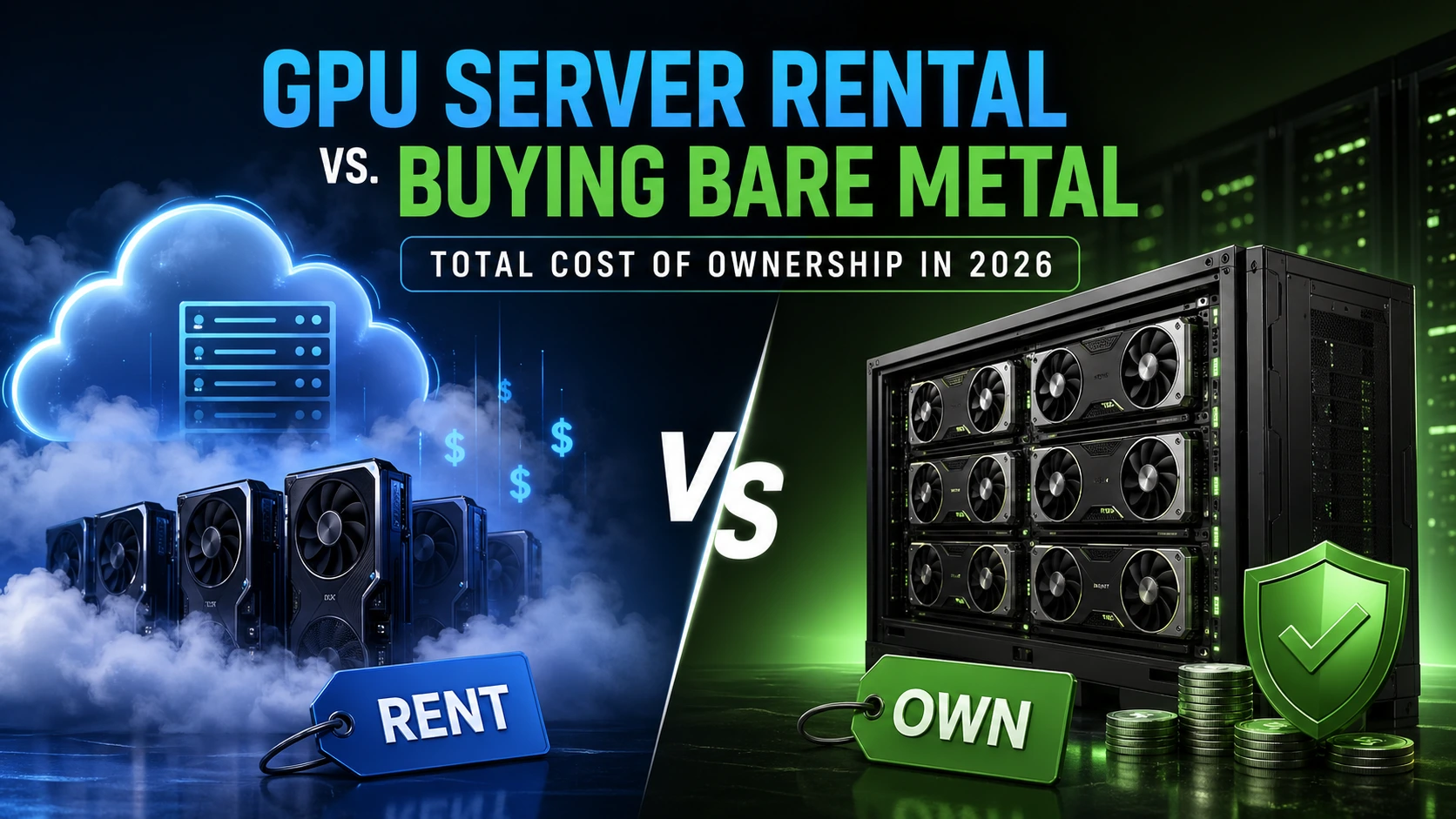
Every AI team, ML engineer, and enterprise computing team eventually hits the same crossroads: keep renting GPU capacity from a cloud provider, or invest in bare metal GPU servers of your own?
On paper, GPU server rental looks flexible and low-risk. In practice, a single NVIDIA H100 cluster running inference 24/7 can quietly rack up costs that dwarf the price of owning the same hardware outright, often within 12 months.
This guide breaks down the real total cost of ownership (TCO) for both paths in 2026, covering hardware acquisition, power, colocation, maintenance, staffing, and the hidden fees most providers bury in the footnotes. Whether you're scaling a generative AI product, training large language models, or running GPU-accelerated HPC workloads, these numbers will help you make a decision you won't regret a year from now.
What "Total Cost of Ownership" Actually Means for GPU Infrastructure
TCO isn't just the sticker price of a server or the hourly rate on a rental dashboard. For GPU infrastructure, a complete TCO picture includes six cost layers:
-
1. Acquisition or Rental Cost: hardware purchase or cloud/dedicated rental fees
-
2. Colocation and Hosting: rack space, power delivery, and bandwidth at a data center
-
3. Energy and Cooling: GPU servers are power-hungry; A single H100 SXM5 has a peak TDP of ~700W, with real-world system-level power draw significantly higher when accounting for CPUs, memory, and networking.
-
4. Networking: InfiniBand or high-speed Ethernet for GPU clusters adds up fast
-
5. Operations and Staffing: provisioning, monitoring, firmware updates, and incident response
-
6. Opportunity Cost and Scalability Risk: the cost of being locked into the wrong capacity
Skipping any one of these layers leads to budget surprises. The sections below examine both GPU rental and bare metal ownership through all six lenses.
GPU Server Rental in 2026: What You're Really Paying For
Current Market Rates for GPU Cloud Rentals
The GPU rental market has matured significantly. In 2026, pricing for on-demand dedicated GPU instances breaks down roughly as follows:
| GPU Model | On-Demand Hourly Rate | Monthly (730 hrs) | Annual Equivalent |
|---|---|---|---|
| NVIDIA H100 SXM5 (80GB) | $2.80 – $4.50/hr | $2,044 – $3,285 | $24,528 – $39,420 |
| NVIDIA H100 NVL (94GB) | $3.20 – $5.00/hr | $2,336 – $3,650 | $28,032 – $43,800 |
| NVIDIA A100 (80GB) | $1.60 – $2.80/hr | $1,168 – $2,044 | $14,016 – $24,528 |
| NVIDIA RTX 4090 (24GB) | $0.60 – $1.20/hr | $438 – $876 | $5,256 – $10,512 |
| AMD MI300X (192GB) | $2.40 – $4.00/hr | $1,752 – $2,920 | $21,024 – $35,040 |
Pricing varies significantly by region, contract structure, and supply availability. The ranges below reflect blended averages across major 2026 providers.
8× H100 cluster running full-time for one year? You're looking at $196,224 – $315,360 at on-demand pricing, before networking, storage, or egress fees.
Hidden Costs in GPU Cloud Rentals Most Teams Overlook
Rental dashboards show the headline hourly rate. They rarely lead with these:
-
Egress fees: Moving large model checkpoints or datasets out of a cloud environment can cost $0.08–$0.12/GB. A team regularly syncing 10TB of training data monthly pays $800–$1,200 in egress alone.
-
Storage overhead: NVMe-backed block storage attached to GPU instances typically runs $0.15–$0.25/GB/month. A 50TB dataset costs $7,500–$12,500 per month in storage.
-
Idle time: GPU instances billed by the hour accrue cost whether your job is running or your node is waiting on data. Utilization below 70% is common in poorly optimized pipelines.
-
Reserved instance lock-in: 1- or 3-year reserved contracts reduce per-hour pricing but eliminate flexibility. Cancelling early forfeits the discount retroactively with most providers.
-
Support tiers: Enterprise-grade SLA support (guaranteed response times, dedicated account management) adds $500–$3,000/month depending on cluster size.
Where GPU Rental Makes Genuine Financial Sense
GPU rental is the right call when:
-
Your GPU workload is bursty or seasonal (model training spikes, quarterly reporting, event-driven inference)
-
You're still in the R&D or proof-of-concept phase, and hardware requirements aren't stable
-
Your team lacks dedicated infrastructure engineers to manage bare metal
-
You need GPUs that are too new or too expensive to justify immediate capital expenditure (e.g., NVIDIA Blackwell B200 early in its lifecycle)
-
You need geographic distribution across regions that don't yet have a physical presence
Buying Bare Metal GPU Servers: Acquisition, Colocation, and Real Ongoing Costs
GPU Hardware Acquisition Costs in 2026
The capital expenditure side of bare metal GPU servers in 2026 reflects a market where NVIDIA Hopper-generation hardware has stabilized in price, while Blackwell-architecture GPUs command a significant premium:
| Server Configuration | Acquisition Cost (Approx.) |
|---|---|
| 4× NVIDIA H100 SXM5 (DGX-class) | $180,000 – $220,000 |
| 8× NVIDIA H100 SXM5 (full DGX H100) | $350,000 – $420,000 |
| 8× NVIDIA H100 PCIe (whitebox) | $240,000 – $290,000 |
| 8× NVIDIA A100 80GB (refurbished) | $90,000 – $140,000 |
| 8× AMD MI300X | $160,000 – $200,000 |
| 4× NVIDIA RTX 4090 (inference node) | $18,000 – $28,000 |
These figures cover GPU cards plus a compatible server platform (dual-socket CPU, high-bandwidth memory, NVMe storage, high-speed networking). They do not include rack space, power infrastructure, or network switches.
Colocation Costs: What It Actually Costs to House a GPU Server
This is where teams building their own GPU infrastructure frequently under-budget. A high-density GPU server draws substantially more power than a standard web server, and data centers price accordingly.
Typical colocation costs for a GPU server (per month):
-
Rack space: A 2U–4U GPU server in a standard half-cabinet runs $150–$400/month, depending on location and provider
-
Power (draw-based pricing): At $0.07–$0.12/kWh and 3–6kW sustained draw per server, expect $150–$525/month in power alone
-
Bandwidth: Unmetered 10GbE ports typically included; 25GbE or 100GbE uplinks cost $100–$400/month extra
-
Remote hands: Occasional physical support (drive swaps, reboots, cable management) typically billed at $50–$150/hour
Monthly colocation cost for a single 8× H100 server: $450 –
$1,325
Annually: $5,400 – $15,900
Some colocation providers offer dedicated server colocation packages designed for high-density GPU workloads, where power density planning, cooling infrastructure, and network redundancy are handled as part of the service, not billed as surprise line items.
Maintenance, Depreciation, and Staffing
Bare metal ownership isn't a one-time purchase. The ongoing cost of ownership includes:
-
Hardware depreciation: GPU servers depreciate 20–35% annually. A $350,000 DGX H100 carries a 3-year book value decline of $245,000–$315,000 over its useful life.
-
Spare parts and warranty: Out-of-warranty GPU replacements cost $10,000–$25,000 per card. Extended hardware warranties run 8–12% of server cost annually.
-
Firmware and driver management: NVIDIA driver updates, BIOS patches, and CUDA compatibility management require dedicated engineering time, typically 5–10 hours/month for a small cluster.
-
Infrastructure engineer salary: A mid-level infrastructure/DevOps engineer managing bare metal GPU clusters costs $90,000–$150,000/year in fully loaded salary and benefits (US market, 2026).
GPU Server Rental vs. Bare Metal: Side-by-Side TCO Comparison
The numbers below compare a representative workload: a team running 8× NVIDIA H100 GPUs at ~80% average utilization for 3 years.
| Cost Category | GPU Rental (3 Years) | Bare Metal + Colo (3 Years) |
|---|---|---|
| Hardware / Rental Fees | $588,000 – $946,000 | $350,000 – $420,000 |
| Colocation / Hosting | Included | $16,200 – $47,700 |
| Power (if billed separately) | Included | $5,400 – $18,900 |
| Storage (50TB) | $270,000 – $450,000 | $8,000 – $15,000 (NAS hardware) |
| Networking (10GbE) | Included | $3,600 – $14,400 |
| Infrastructure staffing (0.3 FTE) | Minimal | $81,000 – $135,000 |
| Maintenance / warranty | Included | $30,000 – $60,000 |
| 3-Year Total TCO | $858,000 – $1,396,000 | $494,200 – $711,000 |
On-prem or colocated storage costs can be significantly lower than cloud block storage, though they require upfront hardware investment and careful planning for redundancy, backups, and failure recovery.
The bare metal advantage at 3 years: $363,800 – $685,000 in savings, assuming sustained, high-utilization workloads.
The storage cost differential is particularly striking. Teams that treat cloud object storage as "essentially free" routinely discover it's one of their top three infrastructure expenses at scale.
Break-Even Analysis: When Does Owning GPU Hardware Beat Renting?
The break-even point between renting and owning depends on three variables: utilization rate, workload duration, and storage requirements.
For an 8× H100 cluster:
-
At 40% utilization (development/testing-heavy workflows): Break-even hits around Month 22–26
-
At 70% utilization (production ML inference + periodic training): Break-even hits around Month 14–18
-
At 90%+ utilization (continuous inference or HPC): Break-even hits around Month 10–13
Break-even timelines can shift if newer GPU architectures significantly outperform existing hardware, reducing the effective lifespan of owned infrastructure.
Practical implication: If your GPU workloads are running continuously and you have a 3-year planning horizon, bare metal ownership delivers dramatically lower TCO. If workloads are unpredictable or you're within 12 months of a major architecture shift (e.g., Blackwell B200 adoption), rental preserves flexibility without forcing a capital bet.
The Hybrid Model: Dedicated GPU Servers as Your Baseline, Cloud as Overflow
The most cost-effective GPU infrastructure strategy in 2026 isn't a binary choice; it's a layered architecture:
-
Layer 1 - Owned Bare Metal at Colocation: Your steady-state, predictable GPU workloads live here. These are production inference endpoints, recurring training jobs, and baseline capacity that runs 24/7. This layer has the lowest per-GPU-hour cost at scale.
-
Layer 2 - Reserved Cloud Instances: For workloads that are planned but not constant, quarterly model retraining, scheduled batch jobs, and reserved 1-year instances at 30–50% discount fill the gap without the capital commitment of owned hardware.
-
Layer 3 - On-Demand Burst Capacity: Unexpected demand spikes, new model experiments, or overflow during peak periods hit on-demand rentals. This layer is expensive per hour but represents a small percentage of total compute time.
This architecture mirrors how sophisticated AI teams at mid-market SaaS companies, research institutions, and financial services firms structure their GPU spend. The colocation layer, your dedicated GPU servers housed in a professionally managed data center, anchors the entire cost model.
Colocation as the Optimal Middle Ground for GPU Workloads
Pure cloud GPU rental and fully self-hosted bare metal represent two extremes. GPU server colocation sits in between — and for most teams at the $500K+ annual compute spend threshold, it's the most rational operating model.
With colocation:
-
You own the hardware (and the depreciation tax benefits, CapEx treatment, and resale value)
-
The data center manages physical infrastructure, power redundancy, cooling, physical security, and network connectivity
-
You control the software stack entirely — no hypervisor overhead, no noisy neighbor effects, no vendor-imposed CUDA version constraints
-
You retain flexibility to upgrade or repurpose hardware as your needs evolve
At KW Servers, our bare metal dedicated server infrastructure is purpose-built for GPU-dense workloads, with power densities up to 30kW per cabinet, redundant 100GbE uplinks, and hands-on remote support. Teams migrating from cloud GPU rentals consistently report 40–65% infrastructure cost reduction after the first full year.
Key Decision Factors Beyond Price
TCO is the foundation, but it's not the only variable in the GPU rental vs. bare metal decision. These factors often tip the scales:
-
Data sovereignty and compliance: Healthcare, finance, and government workloads operating under HIPAA, SOC 2, or data residency regulations often cannot use multi-tenant cloud GPU environments. Bare metal colocation provides the control layer required for compliance.
-
Latency and performance consistency: Cloud GPU instances share physical infrastructure. On bare metal dedicated GPU servers, you get consistent, predictable throughput — no noisy neighbors, no resource contention during peak demand windows.
-
Hardware access timeline: During GPU supply constraints (as seen with H100 allocations in 2023–2024), owning hardware means you have it. Rental availability can dry up precisely when you need scale.
-
Team capability: Bare metal GPU management requires infrastructure expertise. If your team is entirely ML-focused without a DevOps or systems engineering function, the operational overhead of ownership deserves honest accounting.
-
Tax treatment: In many jurisdictions, owned server hardware qualifies for accelerated depreciation, reducing the effective net cost of acquisition in year one.
Frequently Asked Questions
Is it cheaper to rent or buy a GPU server in 2026?
For workloads running at 70%+ utilization for 18+ months, buying bare metal GPU servers and colocating them almost always delivers lower total cost of ownership than renting. At lower utilization or for shorter-term projects, GPU rental is more cost-effective.
What is the total cost of ownership for an 8× H100 server?
Over three years, owning an 8× H100 server at a colocation facility costs approximately $494,000–$711,000 fully loaded (hardware, colo, power, networking, maintenance, staffing). Renting equivalent capacity on-demand costs $858,000–$1,396,000 over the same period.
What hidden fees should I watch for with GPU server rentals?
Data egress fees, object storage costs, idle instance billing, reserved instance cancellation penalties, and premium support tiers are the most common sources of bill shock in GPU rental environments.
What is GPU server colocation?
GPU server colocation means you purchase the GPU server hardware yourself and house it in a professional data center, like KW Servers' dedicated server facilities, that provides power, cooling, physical security, and network connectivity. You retain full control of the hardware and software while offloading physical infrastructure management.
How much does it cost to colocate a GPU server per month?
For a high-density GPU server drawing 3–6kW, expect $450–$1,325/month in total colocation costs, including rack space, power, and basic bandwidth. Enterprise agreements for multi-server GPU clusters typically offer volume pricing that reduces this significantly.
When does a hybrid GPU infrastructure strategy make sense?
When you have both predictable baseline workloads (suited for owned bare metal) and variable burst workloads (suited for on-demand rental), a hybrid model, owned servers at colo plus reserved/on-demand cloud overflow, minimizes both capital risk and per-hour compute cost.
Conclusion: The Math Favors Ownership at Scale — With the Right Infrastructure Partner
The GPU rental vs. bare metal question is fundamentally a utilization and time horizon question. The longer you run, and the more consistently you run, the more expensive renting becomes relative to owning.
For AI teams, ML platforms, and enterprises with stable, high-utilization GPU workloads, the 3-year TCO numbers make a compelling case for dedicated GPU servers in a professional colocation environment. The savings aren't marginal, they're transformational at the $500K+ annual compute spend level.
The critical caveat: bare metal ownership only delivers on its cost promise when the underlying infrastructure is rock-solid. Downtime, power events, and connectivity issues at a poorly managed colocation facility can erode the cost advantage quickly.
At KW Servers, our dedicated server infrastructure is engineered for teams that have done this math and chosen ownership. From single-node GPU deployments to full-rack H100 clusters, we provide the colocation backbone that turns a capital investment into a long-term competitive advantage.
Ready to run your own GPU TCO calculation? Contact our infrastructure team, and we'll model your specific workload against current rental rates and show you exactly where the break-even point falls for your use case.