If you're running workloads on AMD EPYC Genoa-powered dedicated servers, you've probably already experienced the generational leap that Zen 4 architecture brought to the data center. But AMD's fifth-generation EPYC processors, codenamed Turin, have entered the picture, and the question facing infrastructure teams, hosting buyers, and enterprise IT managers is real: is it worth upgrading your dedicated server hardware now, or is Genoa still the smarter investment?
This guide breaks down the architectural differences, real-world performance gains, total cost of ownership, and specific workload scenarios to help you make an informed decision for your infrastructure.
What Is AMD EPYC Turin? Understanding the Fifth-Generation Architecture
AMD EPYC Turin (9005 Series) represents AMD's fifth-generation server processor lineup, built on the Zen 5 and Zen 5c hybrid core architecture. Released in late 2024, Turin marks a significant shift in how AMD approaches core density, memory bandwidth, and AI-adjacent compute at the processor level.
Key architectural highlights of EPYC Turin include:
-
Up to 192 cores per socket using a Zen 5 and high-density Zen 5c core variants, depending on SKU
-
Support for DDR5-6400 memory, improving memory bandwidth substantially
-
PCIe Gen 5 lanes for next-generation NVMe storage and GPU connectivity
-
Advanced branch prediction and wider execution pipelines in Zen 5
-
Improved per-core IPC (Instructions Per Clock) over Zen 4
-
New cache hierarchy optimizations that reduce latency for database and in-memory workloads
The flagship AMD EPYC 9965 (Turin) ships with 192 cores across a single socket — a number that would have been unthinkable in server hardware just a few years ago.
AMD EPYC Genoa Recap: Where the Fourth Generation Stands Today
AMD EPYC Genoa (9004 Series) introduced Zen 4 architecture to the server market and quickly became one of the most competitive dedicated server processor platforms available. With up to 96 cores per socket, PCIe Gen 5 support, DDR5 memory, and a dramatically improved memory subsystem over its Milan predecessor, Genoa redefined expectations for CPU-intensive hosted workloads.
For context, EPYC Genoa processors, such as the EPYC 9654 (96 cores) and EPYC 9554 (64 cores), remain excellent choices for:
-
High-density virtual machine hosting
-
Parallel computing and simulation tasks
-
Enterprise database hosting (MySQL, PostgreSQL, Oracle)
-
High-frequency web servers and API gateways
-
CI/CD pipeline servers with high concurrency
Genoa is not obsolete. It is, however, the previous generation, and that distinction matters depending on your workload trajectory.
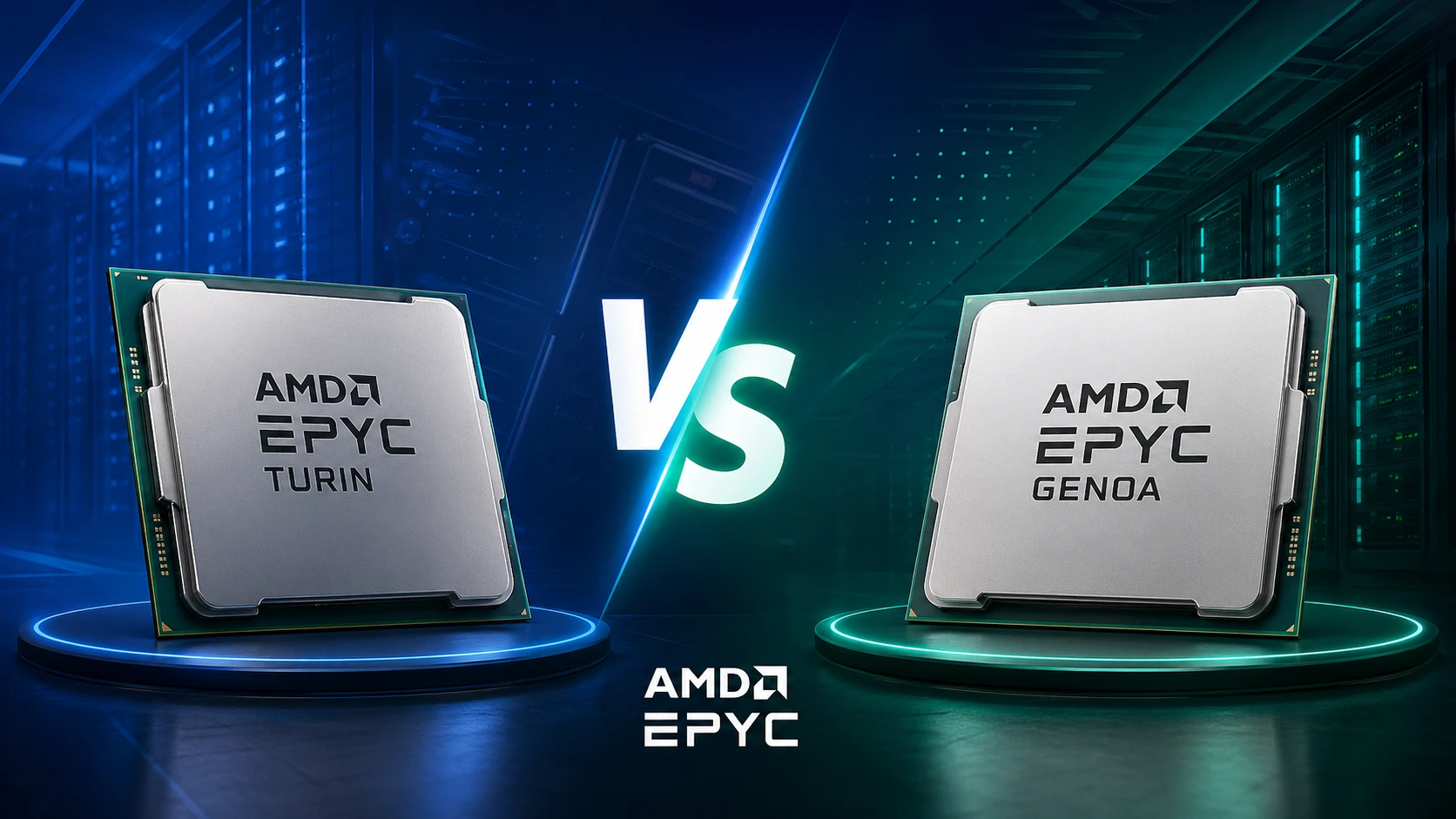
AMD EPYC Turin vs. Genoa: Head-to-Head Comparison
Understanding the difference between these two processor families requires looking beyond raw core counts. Architecture, memory throughput, and platform-level improvements all play a role in how these CPUs perform inside a dedicated server environment.
Core Count and Architecture
| Specification | EPYC Genoa (9004) | EPYC Turin (9005) |
|---|---|---|
| Architecture | Zen 4 | Zen 5 / Zen 5c |
| Max Cores (Single Socket) | 96 | 192 |
| Max Cores (Dual Socket) | 192 | 384 |
| Process Node | TSMC 5nm (compute) | TSMC 3nm (Zen 5) / 4nm (Zen 5c) |
| PCIe Generation | Gen 5 | Gen 5 |
| DDR5 Support | DDR5-4800 | DDR5-6400 |
| Memory Channels | 12 | 12 |
| L3 Cache (max) | Up to 384 MB | Up to 768 MB |
| TDP Range | 200W – 400W | 200W – 500W |
IPC and Per-Core Performance
Zen 5 delivers approximately 10–16% IPC uplift (workload-dependent) over Zen 4 in single-threaded workloads. For dedicated server applications where per-core licensing is relevant, such as Oracle Database, SQL Server, or per-core SaaS platforms, this improvement directly translates into measurable cost efficiency.
In multi-threaded scenarios, the hybrid core design in Turin (mixing full Zen 5 cores with efficiency-oriented Zen 5c cores) means raw throughput on embarrassingly parallel tasks can scale dramatically, particularly on the 192-core variants.
Memory Bandwidth and Latency
One of the less-discussed but critical differences in dedicated server performance is memory bandwidth. Turin's support for DDR5-6400 vs. Genoa's DDR5-4800 represents a roughly up to ~33% higher theoretical bandwidth, with real-world gains depending on workload and memory configuration. For workloads that are memory-bound, large in-memory databases like Redis or SAP HANA, real-time analytics, and HPC simulations, this is a meaningful architectural advantage that shows up directly in benchmarks.
L3 Cache: Turin's Structural Advantage
Turin's L3 cache capacity doubles Genoa's in equivalent configurations. For low-latency workloads such as gaming servers, financial trading applications, and key-value stores, a larger L3 cache reduces DRAM access frequency and meaningfully improves tail latency metrics.
Real-World Workload Analysis: When Turin Wins and When Genoa Is Still Enough
Not every use case justifies an upgrade. Here is a workload-by-workload breakdown to help you assess whether a server upgrade makes business sense.
Web Hosting and WordPress Servers
For standard shared hosting, WordPress managed servers, or LAMP-stack dedicated servers, Genoa remains more than sufficient. The per-request CPU demand of typical CMS workloads doesn't stress even Genoa's lower core-count SKUs. Unless you're running hundreds of concurrent PHP workers or have extremely high traffic volumes, Turin's additional headroom would go largely unused.
Verdict: Genoa is still the right choice for most web hosting scenarios.
Enterprise Database Servers (PostgreSQL, MySQL, MariaDB)
Here, Turin starts to show its advantages. Improved IPC, increased L3 cache, and higher memory bandwidth all directly benefit relational database performance, particularly for complex query execution, large JOIN operations, and high-transaction-per-second environments. If you're running a PostgreSQL cluster serving a SaaS application with thousands of concurrent users, a Turin-based dedicated server delivers measurably better query throughput and lower latency under load.
Verdict: Turin is the recommended upgrade path for production database servers with growing workloads.
Virtualization and VPS Hosting Infrastructure
Providers running VMware ESXi, Proxmox VE, or KVM-based VPS hosting platforms will find Turin's 192-core configurations transformative. More cores per socket means higher VM density per physical server, which directly reduces hardware costs per tenancy. The improved memory bandwidth also benefits hypervisors managing dozens of concurrent VM memory operations.
Verdict: Strong case for Turin in high-density virtualization environments.
AI Inference and Machine Learning Workloads
While dedicated GPU servers remain the primary home for model training, AMD EPYC Turin's wider SIMD execution, enhanced vector execution capabilities, and larger cache hierarchy make it a notably better platform for CPU-side AI inference, particularly for smaller models, transformer pre/post-processing, and embedding generation pipelines. Turin narrows the gap between CPU and GPU inference for certain workloads.
Verdict: Turin is the preferred platform for AI-adjacent CPU compute on dedicated servers.
High-Performance Computing (HPC) and Scientific Simulation
This is where Turin's hybrid core design and memory bandwidth improvements are most impactful. Scientific simulations, computational fluid dynamics, financial modeling, and genomics workloads benefit directly from higher core counts, wider execution pipelines, and faster memory access. Organizations running these workloads on dedicated bare metal servers should prioritize Turin.
Verdict: Turin is the clear upgrade for HPC and simulation workloads.
Game Servers and Real-Time Applications
Game servers, particularly for titles with physics simulation, large player counts (MMO environments, battle royale servers), or Minecraft-style chunk processing, benefit from both per-core IPC gains and cache improvements. Reduced memory latency translates into more consistent frame pacing and lower tick-rate jitter.
Verdict: Turin offers meaningful improvements for latency-sensitive game server hosting.
Total Cost of Ownership: Is the Upgrade Worth the Premium?
AMD EPYC Turin dedicated servers command a price premium over equivalent Genoa configurations. The TCO calculation depends heavily on your specific use case and procurement model.
Factors Favoring Immediate Upgrade to Turin
-
Workload consolidation: If Turin allows you to consolidate two Genoa servers onto one Turin server through higher core density, the hardware and operational savings can outweigh the per-unit cost premium within 12–18 months.
-
Per-core software licensing: For workloads running Oracle, SQL Server, or other per-core-licensed software, a higher IPC means you can do more per licensed core. This can produce significant annual savings on licensing costs alone.
-
Long-term platform investment: Turin platforms will receive a longer support window from AMD and server vendors. Choosing Turin now means your server refresh cycle extends further into the future.
Factors Favoring Staying on Genoa (For Now)
-
Cost per core: For budget-sensitive deployments where maximum core density per dollar matters more than raw performance, Genoa still offers excellent value, particularly as pricing has matured since launch.
-
Workload saturation: If your current Genoa server is running at 20–40% utilization, the incremental performance of Turin provides no practical benefit until your workloads grow.
-
Immediate availability and ecosystem maturity: Genoa has a more mature ecosystem of tested configurations, firmware updates, and compatibility validation from server vendors and hosting providers.
Platform Considerations for Dedicated Server Buyers
Beyond the CPUs themselves, choosing between Genoa and Turin also involves platform-level decisions that affect your infrastructure over the server's operating life.
Socket Compatibility
EPYC Turin uses the SP5 socket, the same socket as EPYC Genoa. This means existing SP5 server platforms can potentially support Turin CPUs through firmware updates, though in practice most vendors recommend validated Turin-specific configurations for production use.
Memory Configuration Best Practices
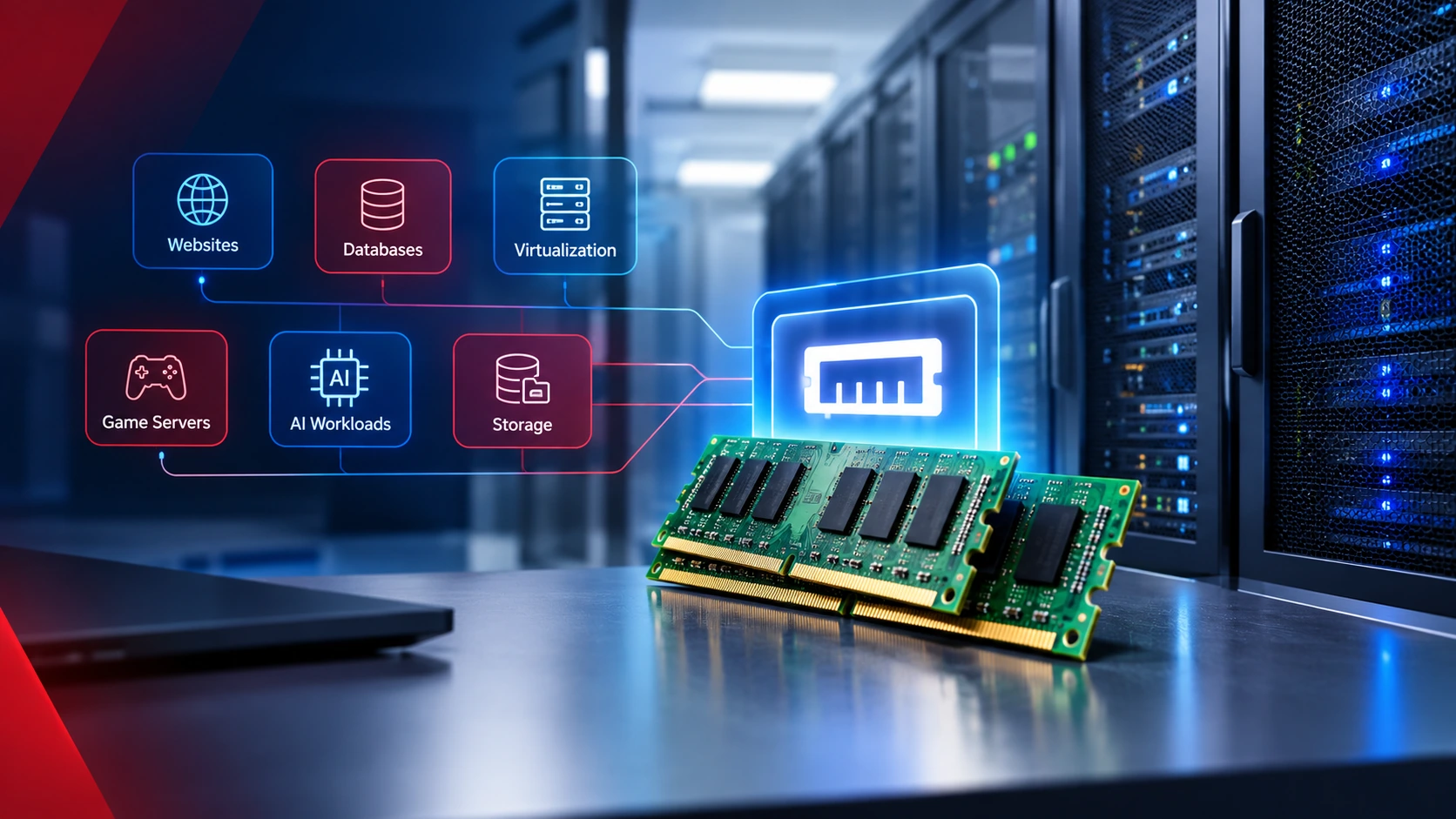
Turin's DDR5-6400 support delivers its full benefit only when paired with appropriate memory modules and configurations. Running DDR5-5200 or lower-frequency DIMMs on a Turin platform captures much of the IPC benefit but leaves memory bandwidth improvements partially unrealized. For memory-intensive workloads, ensure your dedicated server configuration uses DDR5-6400 validated memory.
PCIe Gen 5 Storage and Networking
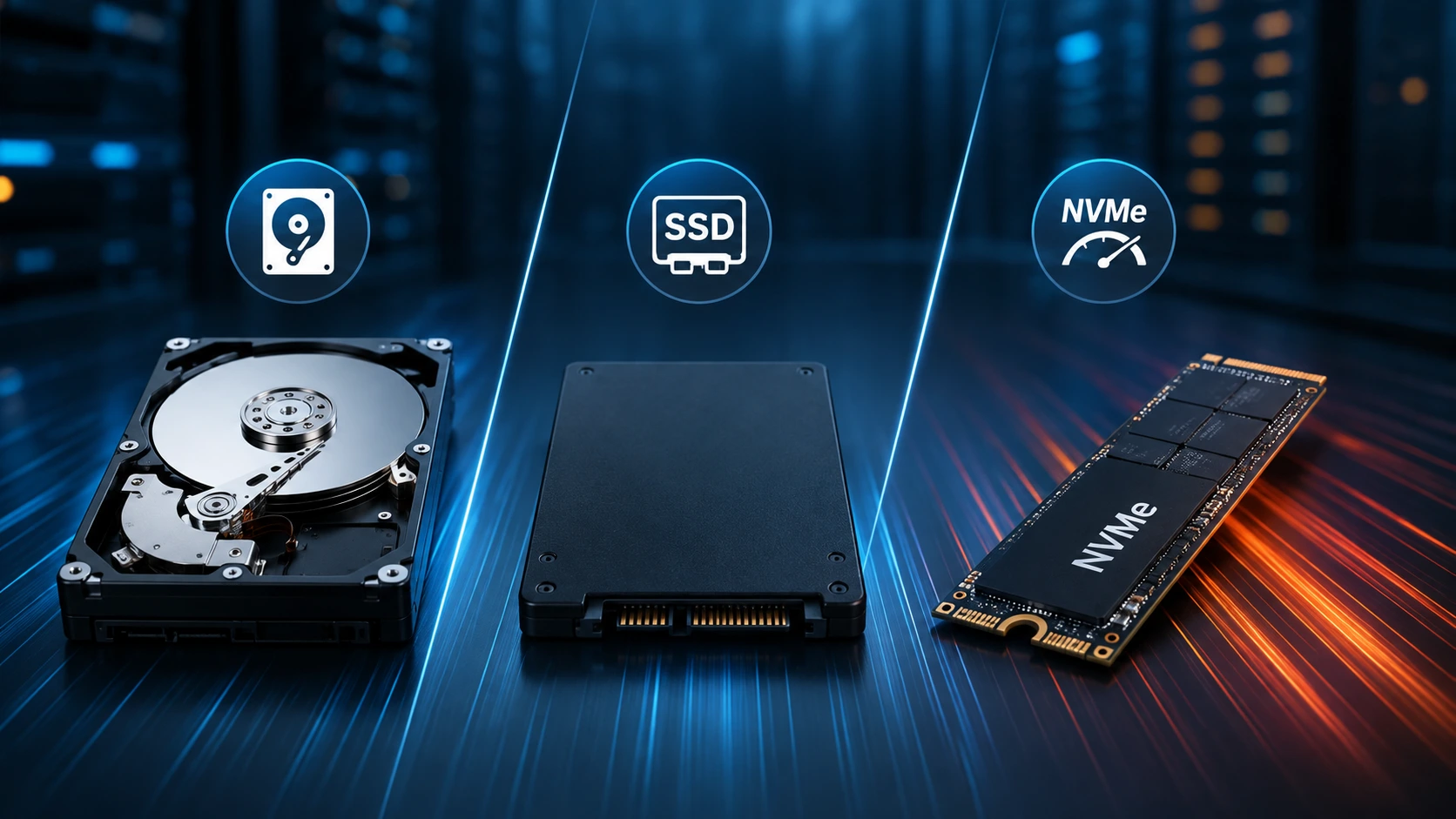
Both Genoa and Turin support PCIe Gen 5, enabling NVMe SSDs with read speeds exceeding 12 GB/s and 400GbE networking adapters. If your workload requires extreme storage throughput or ultra-low network latency, the bottleneck in a Genoa server is unlikely to be the CPU, and Turin won't dramatically change your storage or network performance profile.
EPYC Genoa vs. Turin: Performance Benchmarks Overview
While benchmark results vary significantly by workload type, the following performance improvements are broadly representative of Turin vs. Genoa across server benchmarks published since Turin's launch:
-
SPECrate2017_int_base: Turin shows approximately 15–20% improvement in multi-copy integer workloads
-
SPECrate2017_fp_base: Floating-point throughput gains of 12–18% depending on core configuration
-
Stream Triad (memory bandwidth): Up to 30–35% improvement on Turin with DDR5-6400
-
Database OLTP (pgbench / sysbench): 15–25% improvement in transactions per second for equivalently configured servers
-
Java server benchmarks (SPECjbb): 20–28% throughput improvement on Turin
These are directional figures; your actual performance delta will depend on compiler optimization, memory configuration, OS tuning, and specific application behavior.
Who Should Upgrade to an AMD EPYC Turin Dedicated Server?
Based on the architectural analysis and workload data above, here is a practical summary of who benefits most from moving to EPYC Turin:
Upgrade to Turin if you are:
-
Running production database servers with growing transaction volumes
-
Operating a VPS or virtualization platform needing higher VM density
-
Hosting latency-sensitive applications where L3 cache and IPC matter
-
Working with AI inference, data analytics, or scientific computing
-
Planning a multi-year server deployment and want the longest useful life
-
Running per-core-licensed software where IPC directly reduces licensing costs
Stay on Genoa if you are:
-
Running standard web hosting, WordPress, or CMS workloads
-
Operating servers at low-to-moderate utilization with no near-term growth
-
Cost-optimizing for maximum core count per dollar on parallelizable workloads
-
Deploying for a short-term project with a defined end date
How KW Servers Approaches EPYC Server Configurations
At KW Servers, our dedicated server infrastructure is built around matching the right processor platform to the right workload, not upselling hardware for its own sake. We offer both AMD EPYC Genoa and AMD EPYC Turin dedicated server configurations, allowing you to choose the platform that aligns with your performance requirements and budget.
Our server specialists can help you evaluate your specific workloads, model the TCO across both generations, and determine whether a Turin upgrade represents genuine ROI for your use case, or whether a well-configured Genoa dedicated server continues to serve your needs effectively.
Whether you need a single dedicated server for a critical application or a multi-node bare metal cluster for high-availability infrastructure, understanding the underlying processor architecture is the foundation of making the right infrastructure decision.
Frequently Asked Questions: AMD EPYC Turin vs. Genoa
Is AMD EPYC Turin backward compatible with Genoa server platforms?
Turin and Genoa share the SP5 socket, which means the physical socket is compatible. However, Turin requires specific firmware and VRM support that not all Genoa-era server boards provide. Always verify with your server vendor that a specific Turin CPU is validated for your chassis before planning an in-place upgrade.
Does EPYC Turin support the same ECC memory as Genoa?
Yes. Both Turin and Genoa support ECC (Error-Correcting Code) DDR5 memory, which is standard on enterprise dedicated servers. Turin supports higher frequency DDR5-6400, but it is also backward compatible with lower-speed DDR5 modules.
What is the difference between Zen 5 and Zen 5c cores in EPYC Turin?
Zen 5 cores are full-featured, high-performance cores optimized for single-threaded and lightly threaded workloads. Zen 5c (compact) cores offer lower power consumption and physical die area at the cost of some per-core performance, enabling dramatically higher total core counts. High-core-count Turin SKUs like the EPYC 9965 (192 cores) use both core types to balance throughput and power efficiency.
How does AMD EPYC Turin compare to Intel Xeon in dedicated server performance?
AMD EPYC Turin is broadly competitive with Intel's Xeon Scalable (Granite Rapids) generation in most server workloads, with particular advantages in memory bandwidth, core density, and total platform cost. The competitive landscape between AMD EPYC and Intel Xeon remains workload-dependent, and both platforms have use cases where each holds the advantage.
When will EPYC Turin dedicated servers become widely available from hosting providers?
As of 2025, AMD EPYC Turin dedicated servers are available from a growing number of hosting and bare metal providers. Availability is expanding as server OEMs complete platform validation and supply chains normalize after the initial launch period.
Final Verdict: Turin for New Deployments, Genoa for Cost-Sensitive Workloads
The AMD EPYC Turin vs. Genoa decision ultimately comes down to workload trajectory and total cost of ownership rather than raw specification comparisons. Turin is unambiguously the more capable platform, with higher IPC, more cores, greater memory bandwidth, and a larger cache hierarchy. For organizations building new dedicated server infrastructure in 2025 and beyond, Turin is the forward-looking choice.
For teams with existing Genoa deployments operating at healthy utilization levels, the upgrade calculus depends on whether Turin's performance advantages align with specific bottlenecks you're actively experiencing. If your Genoa server isn't memory-bandwidth bound, cache-limited, or IPC-constrained, the incremental performance of Turin may not justify the hardware cost today.
The good news for dedicated server buyers is that both generations represent AMD's strongest server CPU generations to date, and either platform, properly configured and optimized for your workload, will deliver serious compute performance for years to come.
Looking for AMD EPYC Turin or Genoa dedicated server configurations? Explore KW Servers' dedicated server lineup or speak with our infrastructure team to find the right platform for your workload.