When a business signs up for a dedicated server, the conversation usually starts with CPU cores, RAM capacity, and NVMe storage speed. Those specs matter, but they only tell half the story. The other half lives in a part of the data center most customers never see: the Meet-Me Room (MMR).
A Meet-Me Room is the physical networking hub where internet carriers, cloud platforms, content delivery networks (CDNs), and enterprise networks interconnect inside a facility. It's the reason a dedicated server can stay online during a carrier outage, route traffic efficiently to users on the other side of the world, and maintain the low latency that modern applications depend on.
If you're comparing dedicated server hosting providers, understanding how Meet-Me Rooms work and why they matter will help you make a far smarter decision than comparing processor specs alone.
In this guide, you'll learn:
-
What a Meet-Me Room is and how it functions inside a modern data center
-
Why MMRs are essential to dedicated server reliability and uptime
-
How carrier diversity, BGP routing, and IXP access work together
-
How to evaluate a provider's network infrastructure before you buy
-
Common misconceptions about Meet-Me Rooms
-
Where the technology is heading next
What Is a Meet-Me Room?
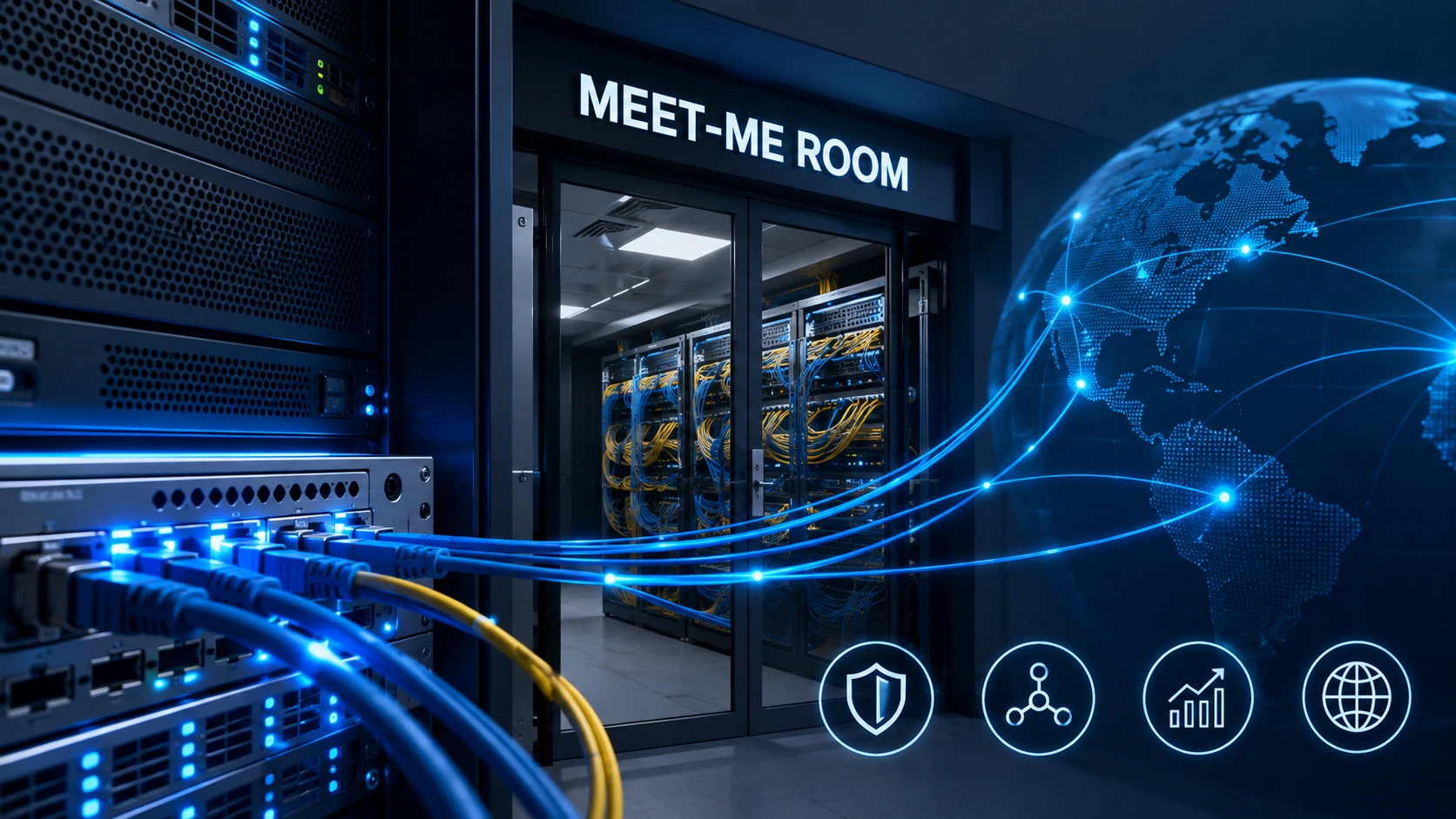
A Meet-Me Room is a secure, carrier-neutral space inside a data center where network providers physically interconnect their infrastructure. Rather than every carrier running a separate cable to every customer rack, each provider terminates its fiber inside the MMR, and customers connect to whichever carriers they need through a cross-connect.
Think of it as the internal "exchange point" of a data center: the place where your dedicated server's traffic meets the wider internet.
This design gives businesses:
-
Access to multiple carriers instead of a single upstream provider
-
Better routing and lower latency
-
Built-in redundancy if one network fails
-
Room to scale bandwidth as traffic grows
-
A stronger foundation for disaster recovery planning
Why Network Infrastructure Is as Important as Server Hardware
A dedicated server is only as reliable as the network behind it. You can deploy the fastest AMD EPYC or Intel Xeon platform with enterprise NVMe drives, and still suffer from:
-
Slow page loads and poor Core Web Vitals scores
-
Elevated latency for international visitors
-
Packet loss and route instability
-
Downtime whenever a single carrier has an outage
Providers that take network architecture seriously combine several layers of infrastructure:
-
Multiple Tier-1 and regional carriers
-
Redundant fiber entrances and diverse physical paths
-
BGP-based routing and multi-homing
-
Carrier-neutral connectivity
-
Internet Exchange Point (IXP) access
-
Redundant core switching
Together, these layers keep a dedicated server reachable even when individual providers fail, which is the entire point of investing in enterprise hosting in the first place.
How a Meet-Me Room Actually Works
Picture a data center hosting thousands of dedicated servers. Instead of wiring every rack directly to every carrier, all providers terminate their backbone fiber inside the MMR. Inside, you'll typically find:
-
Fiber distribution and optical patch panels
-
Cross-connect cabinets
-
Carrier routing equipment
-
Core switches and structured cabling
-
Physical security controls
When a customer requests connectivity through a specific carrier, the data center provisions a cross-connect linking the customer's cabinet to that carrier's equipment in the MMR. A simplified traffic path looks like this:
Dedicated Server → Top-of-Rack Switch → Core Network → Meet-Me Room → Carrier Router → Internet
This centralized model keeps network management simple for the data center while giving customers flexible, scalable connectivity options.
Meet-Me Rooms and Carrier-Neutral Data Centers
A carrier-neutral data center doesn't lock customers into one internet provider. Because multiple carriers terminate inside the same Meet-Me Room, businesses can choose the network that performs best for their use case, and switch or add carriers without relocating hardware.
Carrier neutrality typically delivers:
-
More competitive bandwidth pricing
-
Improved redundancy and failover
-
Flexibility to select carriers by region
-
Easier migration between network providers
-
Reduced vendor lock-in
For a business serving customers across Europe, North America, and Asia, this matters directly: traffic can be routed through whichever carrier performs best in each region, instead of forcing every visitor through the same inconsistent path.
The Role of Cross-Connects
A cross-connect is the physical fiber link between a customer's dedicated server infrastructure and another network inside the Meet-Me Room, a carrier, cloud platform, CDN, IXP, or managed security provider.
Compared with routing over the public internet, a direct cross-connect typically delivers:
-
Lower latency
-
Higher, more predictable bandwidth
-
Reduced packet loss
-
Stronger security posture
-
More consistent application performance
This is why organizations running financial platforms, VoIP systems, SaaS products, game servers, and large-scale databases lean heavily on direct cross-connects rather than public routing alone.
How Meet-Me Rooms Improve Dedicated Server Reliability
1. Multiple Carrier Redundancy
Instead of depending on a single ISP, a dedicated server can reach several independent
carriers. If one provider goes down, traffic reroutes automatically, cutting downtime
dramatically.
2. Smarter Network Routing
More carrier options mean more paths to choose from, which translates into lower
latency, faster load times, and better performance for international traffic.
3. Stronger Fault Tolerance
Fiber cuts and equipment failures happen. A well-designed Meet-Me Room absorbs these
incidents through redundant physical paths and multiple upstream connections, so traffic
shifts to an alternate route instead of dropping entirely.
4. Higher Network Availability
Enterprise hosting environments often target 99.99%+ uptime. Reaching that number
requires carrier diversity, redundant switching, backup power, and multiple fiber
entrances, all coordinated through the Meet-Me Room.
Meet-Me Rooms and Low-Latency Connectivity
Milliseconds matter more than most buyers realize. Latency directly affects:
-
Online gaming and real-time multiplayer sessions
-
Financial trading and market data delivery
-
Video conferencing and live streaming
-
Cloud applications and remote desktops
-
AI inference and distributed training workloads
Because Meet-Me Rooms enable direct interconnection between networks instead of longer public-internet routes, they reduce the number of hops data has to travel, which typically means faster packet delivery, lower jitter, and a more stable connection overall.
Meet-Me Rooms and BGP Routing
A Meet-Me Room becomes even more powerful when paired with Border Gateway Protocol (BGP), the routing protocol that underpins the global internet. BGP allows a network to exchange routing information with multiple carriers and dynamically choose the most efficient path for traffic, rather than depending on a single fixed route.
For a dedicated server connected to several carriers through the MMR, BGP enables:
-
Automatic failover during a carrier outage
-
Routing decisions based on real-time network conditions
-
Reduced latency for users in different regions
-
Load balancing across multiple providers
-
Continuous availability during scheduled maintenance
If one upstream carrier experiences congestion or a regional outage, BGP can shift traffic to another available carrier with minimal disruption, a level of resilience that matters enormously for mission-critical infrastructure.
Meet-Me Rooms and Internet Exchange Points (IXPs)
While a Meet-Me Room handles interconnection inside a facility, many data centers also connect directly to Internet Exchange Points (IXPs), locations where hundreds of independent networks exchange traffic directly instead of routing through third-party transit providers.
When a dedicated server's carriers participate in an IXP, traffic often takes shorter, more efficient routes, resulting in:
-
Lower latency
-
Reduced transit costs
-
Faster regional connectivity
-
Better performance for international visitors
-
Greater available bandwidth
Data centers with strong IXP connectivity give hosting providers a real edge in delivering consistently fast service across borders.
Carrier Diversity: A Core Indicator of Data Center Quality
Carrier diversity means a facility connects to multiple independent telecom providers rather than depending on just one. It's one of the clearest signals of a premium data center.
If a facility relies on a single carrier and that carrier suffers a fiber cut, router failure, or DDoS-related disruption, every customer inside is exposed to the same risk. A carrier-neutral facility with ten or more independent providers in its Meet-Me Room absorbs that failure by shifting traffic elsewhere automatically, protecting uptime for every tenant, not just the lucky ones.
Global Connectivity and Hybrid Cloud Support
Most modern businesses don't serve customers from a single region. E-commerce platforms, SaaS products, gaming services, and streaming platforms all need traffic to route efficiently across continents. A well-connected Meet-Me Room lets a hosting provider build a globally optimized network by peering with carriers that perform strongly in each target region.
MMRs also simplify hybrid infrastructure, where dedicated servers handle databases, cloud platforms scale compute, and backup systems sit in a separate region. Direct private interconnection to major cloud providers, instead of routing over the public internet, offers lower latency, higher bandwidth, and more predictable performance for these hybrid deployments.
Meet-Me Rooms and DDoS Resilience
A Meet-Me Room doesn't stop a DDoS attack on its own, but it enables a stronger defense strategy. With access to multiple carriers and specialized security providers, a hosting company can divert malicious traffic, apply upstream filtering, and absorb larger attack volumes without service interruption, a layered approach that's far harder to achieve on a single-carrier network.
Who Benefits Most From Strong Meet-Me Room Connectivity
-
SaaS providers: consistent global availability for distributed customers
-
E-commerce businesses: faster page loads and reliable checkout uptime
-
Media and streaming platforms: reduced buffering, better playback quality
-
Enterprise businesses: stable connectivity for VPNs, ERP, and CRM systems across offices
-
Virtualization platforms (VMware, Proxmox VE, Hyper-V, KVM): resilient networking for live migration, replication, and clustering
-
Managed hosting providers: the redundancy and scalability needed to serve thousands of tenants reliably
How to Evaluate a Data Center's Meet-Me Room Before Choosing a Dedicated Server
Not every data center offers the same level of connectivity, even when marketing pages say "enterprise-grade." Here's what to actually check:
1. Number of Available Carriers
More independent carriers mean more redundancy and better route optimization. Ask your
provider how many upstream carriers are connected, whether they're physically diverse,
and whether additional carriers can be provisioned as you grow.
2. Carrier-Neutral Infrastructure
Confirm the facility isn't locked to a single ISP. Carrier neutrality supports
competitive pricing, easier expansion, and stronger disaster recovery planning.
3. Redundant Fiber Entrances
If every cable enters through a single conduit, carrier diversity alone won't protect
you from a construction accident or fiber cut at that entry point. Multiple physical
entrances are essential.
4. Cross-Connect Availability
Ask whether the provider supports single-mode and multi-mode fiber cross-connects, how
quickly they can be provisioned, and whether bandwidth can scale on demand.
5. BGP and Routing Capabilities
Verify support for BGP, multi-homing, automatic failover, and traffic engineering; these
features directly determine how resilient your dedicated server will be during a network
incident.
Common Misconceptions About Meet-Me Rooms
-
"Meet-Me Rooms are only for large enterprises." Not true; a business running a single dedicated server benefits from the same redundancy and lower latency as a large enterprise deployment.
-
"A powerful server guarantees strong performance." Hardware is only half the equation. Even a top-tier AMD EPYC or Intel Xeon server can't compensate for poor routing, network congestion, or limited carrier options.
-
"All data centers offer similar connectivity." Some facilities peer with dozens of carriers and IXPs; others rely on just one or two providers. The gap shows up directly in latency, availability, and route efficiency.
-
"Meet-Me Rooms only matter for big cloud providers." Any organization running dedicated servers, regardless of size, gains better redundancy, lower latency, and stronger disaster recovery from a well-built MMR.
Where Meet-Me Room Connectivity Is Heading
-
Higher-speed interconnects: 100GbE, 400GbE, and 800GbE links increasingly support AI workloads and large-scale virtualization.
-
AI-driven network optimization: machine learning is being applied to traffic routing, congestion prediction, and fault detection.
-
Expanding edge connectivity: as edge computing grows, MMRs increasingly link regional carriers, edge facilities, and CDNs to push services closer to users.
-
Deeper hybrid multi-cloud integration: dedicated servers, private cloud, public cloud, and colocation infrastructure are converging, and Meet-Me Rooms are the connective layer that makes it work securely.
Best Practices When Choosing a Dedicated Server Provider
-
Prioritize carrier diversity over a single "big name" carrier
-
Choose a carrier-neutral facility for long-term flexibility
-
Monitor latency, packet loss, jitter, and route changes continuously
-
Plan ahead for additional bandwidth, cross-connects, and cloud integration
-
Evaluate the whole infrastructure stack — power redundancy, cooling, storage, and networking — not server specs in isolation
Frequently Asked Questions
What is a Meet-Me Room in a data center?
It's a secure, carrier-neutral space inside a data center where ISPs, cloud platforms, and enterprise networks physically interconnect, improving flexibility, redundancy, and connectivity for hosted infrastructure.
Why does a Meet-Me Room matter for dedicated servers?
It gives a dedicated server access to multiple carriers instead of one, which improves latency, uptime, routing efficiency, and overall network redundancy.
Does a Meet-Me Room actually improve website speed?
Indirectly, yes. Better routing, lower latency, and direct carrier connectivity all contribute to faster load times, particularly for visitors outside your server's home region.
What does "carrier-neutral" mean?
A carrier-neutral data center isn't restricted to one internet provider; customers can choose from multiple carriers, which improves flexibility and resilience.
Do small businesses benefit from Meet-Me Rooms too?
Yes. Reliable connectivity, better uptime, and stronger network resilience matter just as much for a single dedicated server as they do for a large enterprise deployment.
Final Thoughts
Choosing a dedicated server is about more than comparing processors, memory, and storage. The network infrastructure behind that server, and specifically, the quality of the data center's Meet-Me Room, determines how it actually performs in the real world: latency, uptime, and resilience during carrier failures.
A well-built Meet-Me Room enables carrier diversity, efficient BGP routing, IXP access, and scalable connectivity — the foundation for genuinely reliable hosting.
At KW Servers, network architecture is treated as a core part of every dedicated server deployment, not an afterthought. Combined with enterprise-grade hardware, redundant power, and advanced cooling, a strong Meet-Me Room is what allows a dedicated server to deliver consistent performance for users anywhere in the world.